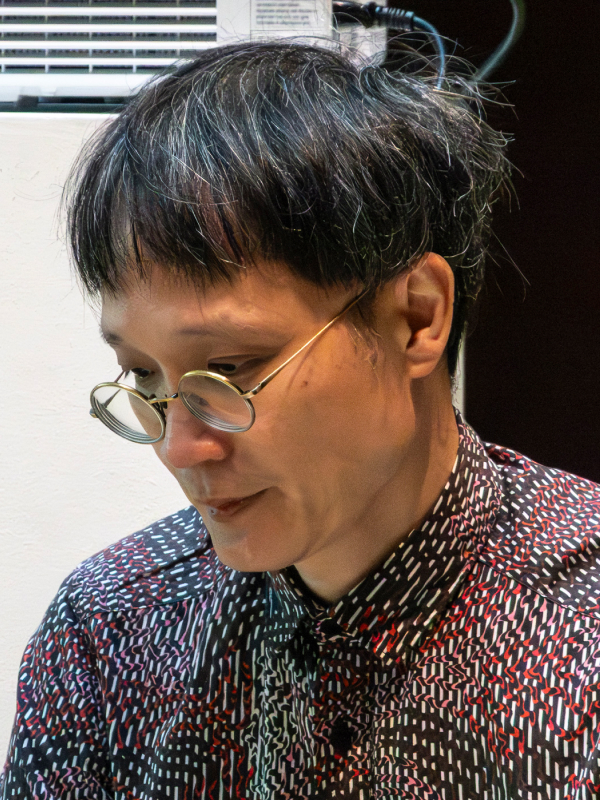
Chi-Wei Lin is a Taiwan-born, Paris-based sound artist and researcher whose practice explores collective participation, sound, and social coordination. Since the 1990s, he has developed works in which scores function less as representations of music than as protocols for organizing collective action. His long-term research has evolved into HDCM (Human Dynamic Coordination Model), a framework for protocol-based art using only the human body as a medium, embodied transmission, distributed decision-making, latency, feedback, and collective interpretation. Drawing on sound art, cybernetics, ritual, and the tradition of Li–Yue (禮樂), his work investigates how minimal rules can generate complex sonic forms and temporary modes of social organization.
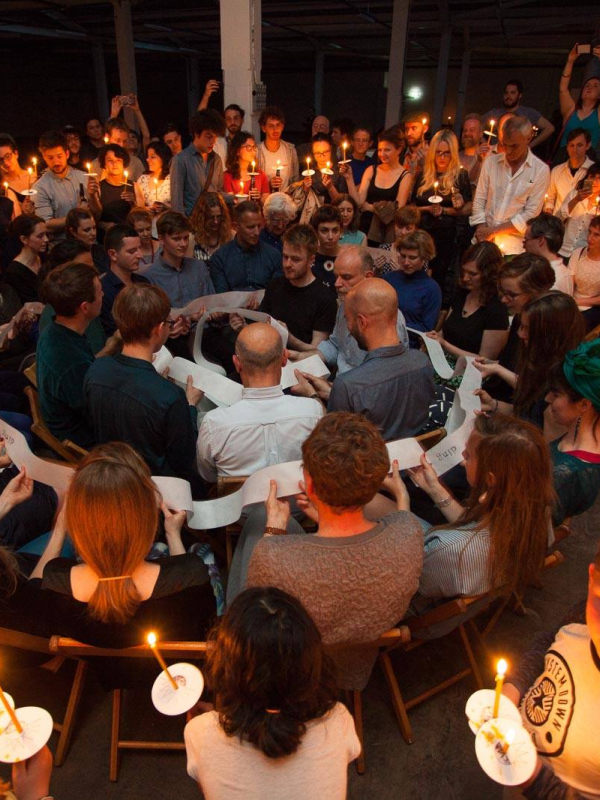
Tape Music is a collective sound project developed by Chi-Wei Lin since 2004. Phonetic instructions are woven into a long textile ribbon, which participants read, vocalize, and pass sequentially from one to another. Without a conductor or unified clock, its sonic structure emerges through transmission, delay, misreading, and mutual adjustment. Rather than representing a predetermined composition, the score functions as a protocol that organizes collective action while leaving space for individual interpretation. Tape Music became an early core practice of HDCM (Human Distributed Dynamic Coordination Model), exploring how simple rules can generate complex and unpredictable collective forms.